publications
publications by categories in reversed chronological order. generated by jekyll-scholar.
2025
-
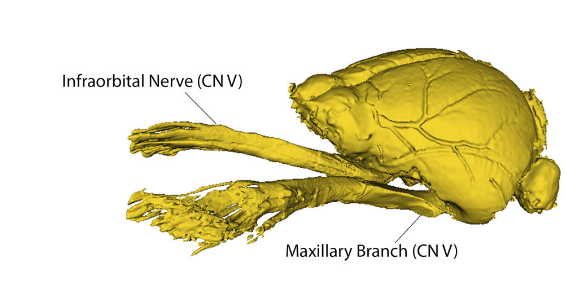 Variation and disparity within the inner ear and trigeminus of the tenrecomorphaR. Benjamin Sulser and Ross D. E. MacPheeCommunications Biology, Jul 2025
Evolutionary theory predicts that sensory systems should adaptively respond to environmental selection. Different ecological niches should, in theory, then correlate with changes in sensory anatomy in lineages that have undergone extensive radiation. The afrotherian clade Tenrecomorpha, comprising of African potamogalines and Malagasy tenrecines, is of particular interest because of its variety: the clade reportedly includes fossorial, arboreal, semiaquatic, and even echolocating taxa. To investigate their sensory ecology, we provide geometric morphometric analyses of inner ear endocasts of 24 tenrec species. We expand this dataset with 9 iodine-stained specimens to study trigeminal organization. Although tenrecomorphs display cross-taxon differences in sensory structures, our analyses distinguish signals of conflicting strength and direction within the tenrec ear, with no single factor that might explain a substantial portion of observed variation when accounting for phylogeny. This contrasts with prior studies of the tenrec cranial endocast, where sensory ecotype and habitat are strongly associated with shape. Iodine-enhanced scans of the trigeminal nerve align with this, and other studies based on bony anatomy. The disparate patterns of shape evolution in Tenrecomorpha and the contrasts exhibited by the inner ear and trigeminal nerve provide a nuanced portrait of neurosensory adaptation, differing from expectations set by other mammalian groups.
@article{sulser_variation_2025,
  title = {Variation and disparity within the inner ear and trigeminus of the tenrecomorpha},
  volume = {8},
  copyright = {2025 The Author(s)},
  issn = {2399-3642},
  url = {https://www.nature.com/articles/s42003-025-08489-8},
  doi = {10.1038/s42003-025-08489-8},
  language = {en},
  number = {1},
  urldate = {2025-11-26},
  journal = {Communications Biology},
  publisher = {Nature Publishing Group},
  author = {Sulser, R. Benjamin and MacPhee, Ross D. E.},
  month = jul,
  year = {2025},
  keywords = {Evolution, Ecology, Zoology},
  pages = {1090},
}
2023
- Transverse Canal Foramen and Pericarotid Venous Network in Metatheria and Other MammalsRoss D.E. MacPhee, Charlène Gaillard, Analía M. Forasiepi, and 1 more authorBulletin of the American Museum of Natural History, Jun 2023
-
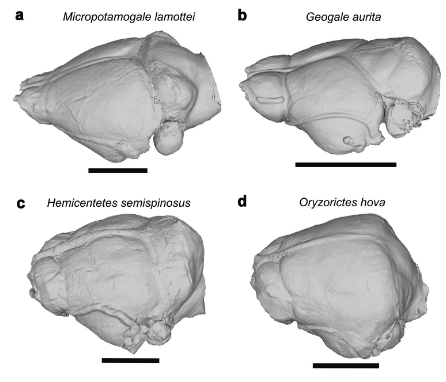 An island apart: Cranial endocast variation and sensory function in TenrecomorphaR. B. Sulser and Ross D. E. MacPheeJournal of Mammalian Evolution, Jun 2023
It has long been recognized that, among extant mammals, the afrotherian clade Tenrecomorpha contains an exceptional range of sensory specialists in which arboreal, fossorial, semiaquatic and possibly even echolocating species occur within a single clade. Despite their obvious interest in this regard, the sensory apparatus of these animals has not been investigated with modern techniques. Presented here is a geometric morphometric analysis of virtual endocasts of 24 tenrecomorph species (~ 69% of extant diversity) reconstructed via high-resolution uCT techniques. Utilizing linear regression and PCA analyses we identify a model including allometry, habitat, and evolutionary history as the main factors underlying shape variability. Distinct clusters in the tenrecomorph morphospace correspond to shifts within the olfactory and cortical regions of the brain, which covary with independent evolution of aquatic and fossorial behaviors. These results showcase remarkable instances of sensory convergence within the clade and provide a template for inter- and intra-clade analyses of this distinctive branch of the mammal tree.
@article{sulser_island_2023,
  title = {An island apart: {Cranial} endocast variation and sensory function in {Tenrecomorpha}},
  issn = {1573-7055},
  shorttitle = {An island apart},
  url = {https://doi.org/10.1007/s10914-023-09662-8},
  doi = {10.1007/s10914-023-09662-8},
  language = {en},
  urldate = {2023-08-17},
  journal = {Journal of Mammalian Evolution},
  author = {Sulser, R. B. and MacPhee, Ross D. E.},
  month = jun,
  year = {2023},
  keywords = {Evolution, Tenrecidae, Morphometrics, Endocast},
}
2022
-
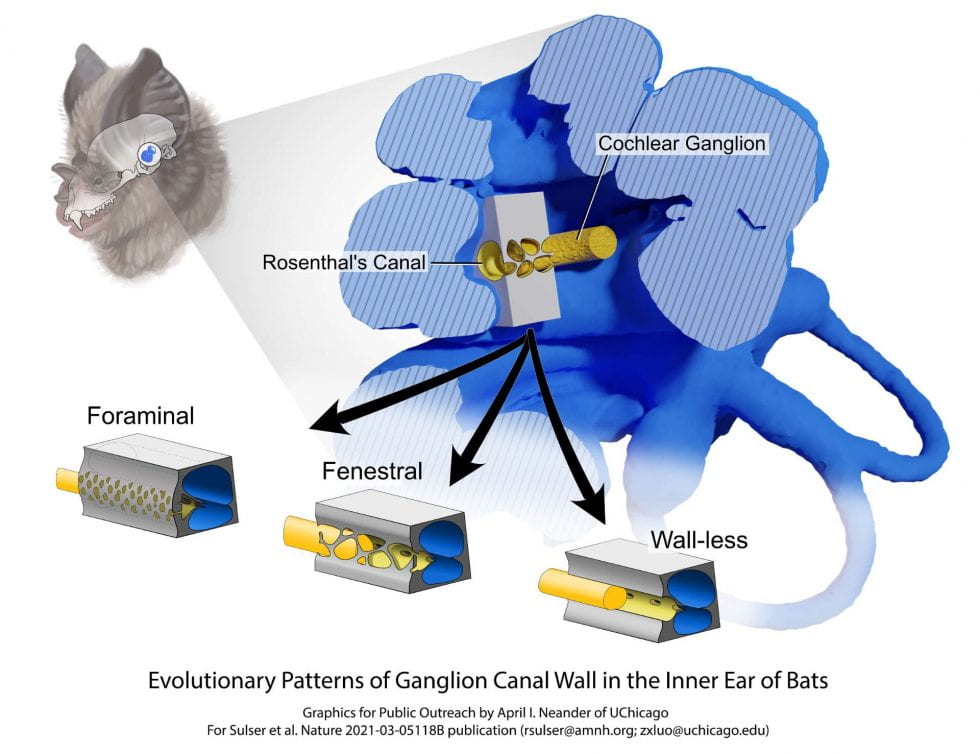 Evolution of inner ear neuroanatomy of bats and implications for echolocationR. Benjamin Sulser, Bruce D. Patterson, Daniel J. Urban, and 2 more authorsNature, Jan 2022
Phylogenomics of bats suggests that their echolocation either evolved separately in the bat suborders Yinpterochiroptera and Yangochiroptera, or had a single origin in bat ancestors and was later lost in some yinpterochiropterans1–6. Hearing for echolocation behaviour depends on the inner ear, of which the spiral ganglion is an essential structure. Here we report the observation of highly derived structures of the spiral ganglion in yangochiropteran bats: a trans-otic ganglion with a wall-less Rosenthal’s canal. This neuroanatomical arrangement permits a larger ganglion with more neurons, higher innervation density of neurons and denser clustering of cochlear nerve fascicles7–13. This differs from the plesiomorphic neuroanatomy of Yinpterochiroptera and non-chiropteran mammals. The osteological correlates of these derived ganglion features can now be traced into bat phylogeny, providing direct evidence of how Yangochiroptera differentiated from Yinpterochiroptera in spiral ganglion neuroanatomy. These features are highly variable across major clades and between species of Yangochiroptera, and in morphospace, exhibit much greater disparity in Yangochiroptera than Yinpterochiroptera. These highly variable ganglion features may be a neuroanatomical evolutionary driver for their diverse echolocating strategies4,14–17 and are associated with the explosive diversification of yangochiropterans, which include most bat families, genera and species.
@article{sulser_evolution_2022,
  title = {Evolution of inner ear neuroanatomy of bats and implications for echolocation},
  copyright = {2022 The Author(s), under exclusive licence to Springer Nature Limited},
  issn = {1476-4687},
  url = {https://www.nature.com/articles/s41586-021-04335-z},
  doi = {10.1038/s41586-021-04335-z},
  language = {en},
  urldate = {2022-01-27},
  journal = {Nature},
  publisher = {Nature Publishing Group},
  author = {Sulser, R. Benjamin and Patterson, Bruce D. and Urban, Daniel J. and Neander, April I. and Luo, Zhe-Xi},
  month = jan,
  year = {2022},
  keywords = {Phylogenetics, Animal behaviour, Evolutionary theory},
  pages = {1--6},
}
2021
- Cranial morphology and phylogenetic relationships of Trigonostylops wortmani, an Eocene South American Native UngulateR. D. E. MacPhee, Santiago Hernández Del Pino, Alejandro Kramarz, and 3 more authorsBulletin of the American Museum of Natural History, Apr 2021
In 1933 George G. Simpson described a remarkably complete skull of Trigonostylops, an Eocene South American native ungulate (SANU) whose relationships were, in his mind, quite uncertain. Although some authorities, such as Florentino Ameghino and William B. Scott, thought that a case could be made for regarding Trigonostylops as an astrapothere, Simpson took a different position, emphasizing what would now be regarded as autapomorphies. He pointed out a number of features of the skull of Trigonostylops that he thought were not represented in other major clades of SANUs, and regarded these as evidence of its phyletic uniqueness. Arguing that the lineage that Trigonostylops represented must have departed at an early point from lineages that gave rise to other SANU orders, Simpson reserved the possibility that Astrapotheriidae might still qualify (in modern terms) as its sister group. Even so, he argued that the next logical step was to place Trigonostylops and its few known allies in a separate order, Trigonostylopoidea, coordinate with Astrapotheria, Notoungulata, Litopterna, and Pyrotheria. Simpson’s classification was not favored by most later authors, and in recent decades trigonostylopids have been almost universally assigned to Astrapotheria. However, his evaluation of the allegedly unique characters of Trigonostylops and its allies has never been systematically treated, which is the objective of this paper. Using computed tomography, the skull of Trigonostylops is compared, structure by structure, to a variety of representative SANUs as well as extant perissodactylans (which together comprise the clade Panperissodactyla) and the “condylarthran” Meniscotherium. In addition to placing Simpson’s character evaluations in a comparative context, we also provide detailed assessments of many vascular and pneumatization-related features of panperissodactylans never previously explored. Overall, we found that this new assessment strengthened the placement of Trigonostylops within a monophyletic group that includes Astrapotherium and Astraponotus, to the exclusion of other SANU clades. Although Trigonostylops cannot be considered as morphologically distinct or unusual as Simpson thought, our comparative and phylogenetic analyses have helped to generate a number of hypotheses about character evolution and function in SANUs that may now be fruitfully tested using other taxon combinations.Reconstruction of Trigonostylops wortmani by Jorge Blanco.